
Among the gems that have been uncovered in our work for The Lutheran Missal, one shines with particular brightness: the compilation reading from Zechariah which beautifully weaves together a string of prophecies concerning our Lord’s passion. That the Holy Spirit foretold the events of the Crucifixion is no surprise to Christians familiar with Psalm 22 and Isaiah 53. These chapters read almost as eyewitness accounts of the Passion. Zechariah’s account is less well known, chiefly because it is not drawn from a single passage or chapter, but from the whole book. Rather than say more, I will let this reading for Holy Week (Holy Monday or Palm Sunday) speak for itself:
(God the Father)
Thus says the LORD God: “Sing and rejoice, O daughter of Zion! For behold, I am coming and I will dwell in your midst. Many nations shall be joined to the LORD in that day, and they shall become My people. And I will dwell in your midst. Jerusalem shall be called the City of Truth, the Mountain of the LORD of hosts, the Holy Mountain. The city shall be full of boys and girls playing in its streets. Behold, I will save My people from the land of the east and from the land of the west; I will bring them back, and they shall dwell in the midst of Jerusalem. They shall be My people and I will be their God, in truth and righteousness. Rejoice greatly, O daughter of Zion! Shout, O daughter of Jerusalem! Behold, your King is coming to you; He is just and having salvation, lowly and riding on a donkey, a colt, the foal of a donkey. He shall speak peace to the nations; His dominion shall be ‘from sea to sea, and from the River to the ends of the earth,’” says the LORD.
(God the Son)
Then I said to them, “If it is agreeable to you, give Me My wages; and if not, refrain.” So they weighed out for My wages thirty pieces of silver—that princely price they set on Me. Then they will look on Me whom they pierced. Yes, they will mourn for Him as one mourns for his only son, and grieve for Him as one grieves for a firstborn. And one will say to Him, “What are these wounds between Your arms?” Then He will answer, “Those with which I was wounded in the house of My friends.”
(God the Father)
“Awake, O sword, against My Shepherd, against the Man who is My Companion,” says the LORD of hosts. “Strike the Shepherd, and the sheep will be scattered.” It shall come to pass in that day that there will be no light; the lights will diminish. It shall be one day which is known to the LORD—neither day nor night. But at evening time it shall happen that it will be light. And in that day it shall be that living waters shall flow from Jerusalem, and the LORD shall be King over all the earth.
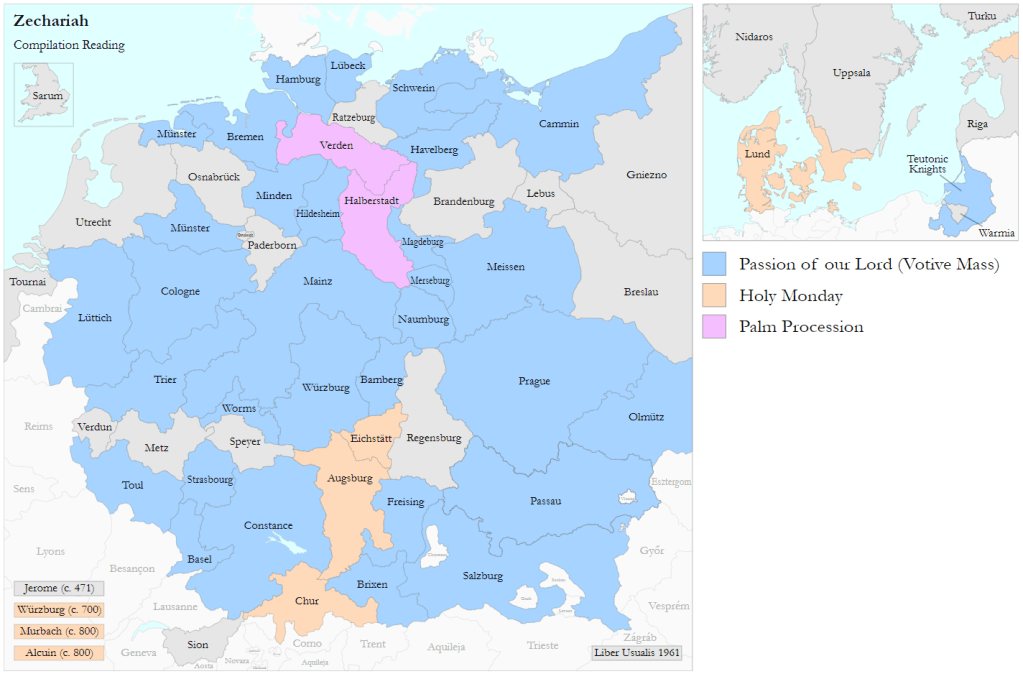
This compilation first appeared some thirteen centuries ago (Würzburg Comes, c. 700), though not yet in finished form. Six versions of the reading can be found in our sources, spanning a period of more than 850 years. The most ancient tradition assigns this reading to Holy Monday as a rare, third reading. By the beginning of the sixteenth century, the custom of a third reading on Holy Monday had disappeared in all but a few dioceses. Most retained the Zechariah compilation in a votive mass for the Passion. In two dioceses, however, Zechariah was read in place of Exodus 16 for the Palm Sunday Procession: Halberstadt and Verden (which used the Halberstadt missal). The final form of the compilation, printed in the Halberstadt 1511 missal and reproduced above, is easily the best.
The editors of The Lutheran Missal are generally opposed to providing alternate readings for a given day, but the Zechariah compilation is the single exception (at present) to this principle. We could not replace the historic Exodus 16 reading for the Palm Sunday Procession with Zechariah on the strength of one or two witnesses. But we do provide it as an alternate, in accord with the historic practice of the dioceses of Halberstadt and Verden. I have used the Zechariah reading in my parish for the last three years on Palm Sunday and it has been glorious. (One could almost title it: The Passion of Our Lord Jesus Christ according to Zechariah, since it describes even the darkness that occurred during the Crucifixion). If you choose to follow suit in your parish, I don’t recommend printing the full reference: Zechariah 2:10–11a; 8:3b, 5, 7–8; 9:9, 10b; 11:12, 13b; 12:10b; 13:6b–7a; 14:6–8a, 9a. Instead, consider: Zechariah (compilation).
Some final thoughts about compilation readings: The idea of assembling a single reading from a number of verses or even half-verses may offend our modern sense of academic propriety. We may also wonder if this doesn’t lift these portions of Scripture from their original contexts. Can we say, “The Word of the Lord” at the conclusion of the reading? Our fathers did not seem to have such qualms, having rightly understood that the central context of all Scripture is Christ. He Himself is the eternal Word of God, and the Zechariah compilation clearly confesses Christ as such, according to the rule of faith. The Octave of Epiphany (Baptism of Our Lord) contains another such compilation. According to modern standards, the precise biblical reference for this Prophecy would be: Isaiah 25:1; 26:11a; 28:5a; 35:1a, 2b, 10a; 41:18a, c; 52:13b; 12:3–5. But the saints of old were less concerned with such precision—and, perhaps, more concerned with Christ. Magdeburg 1613 (a Lutheran cathedral book), for example, lists the reference simply as being from Isaiah 12 and 25. It is worth noting that the Isaiah compilation appears in finished form around 800 AD. Since that time it has been universally attested as the Prophecy for the Octave of Epiphany. What’s more, in every one of our 59 sources in which it appears—including the Lutheran ones—it is without variation of any kind.
 The Lutheran Missal
Extremely interesting! Zechariah is chock full of Christological prophetic allusions. Seeing them in organized into a unit and then using it in Passiontide/Holy Week worship is stellar. Great example of how the Scriptures testify about Christ, but they do have to be opened up to be understood. (It’s not all one simple block-by-block text.) Those fathers in the faith have shown us a good way to do that.
LikeLiked by 1 person